


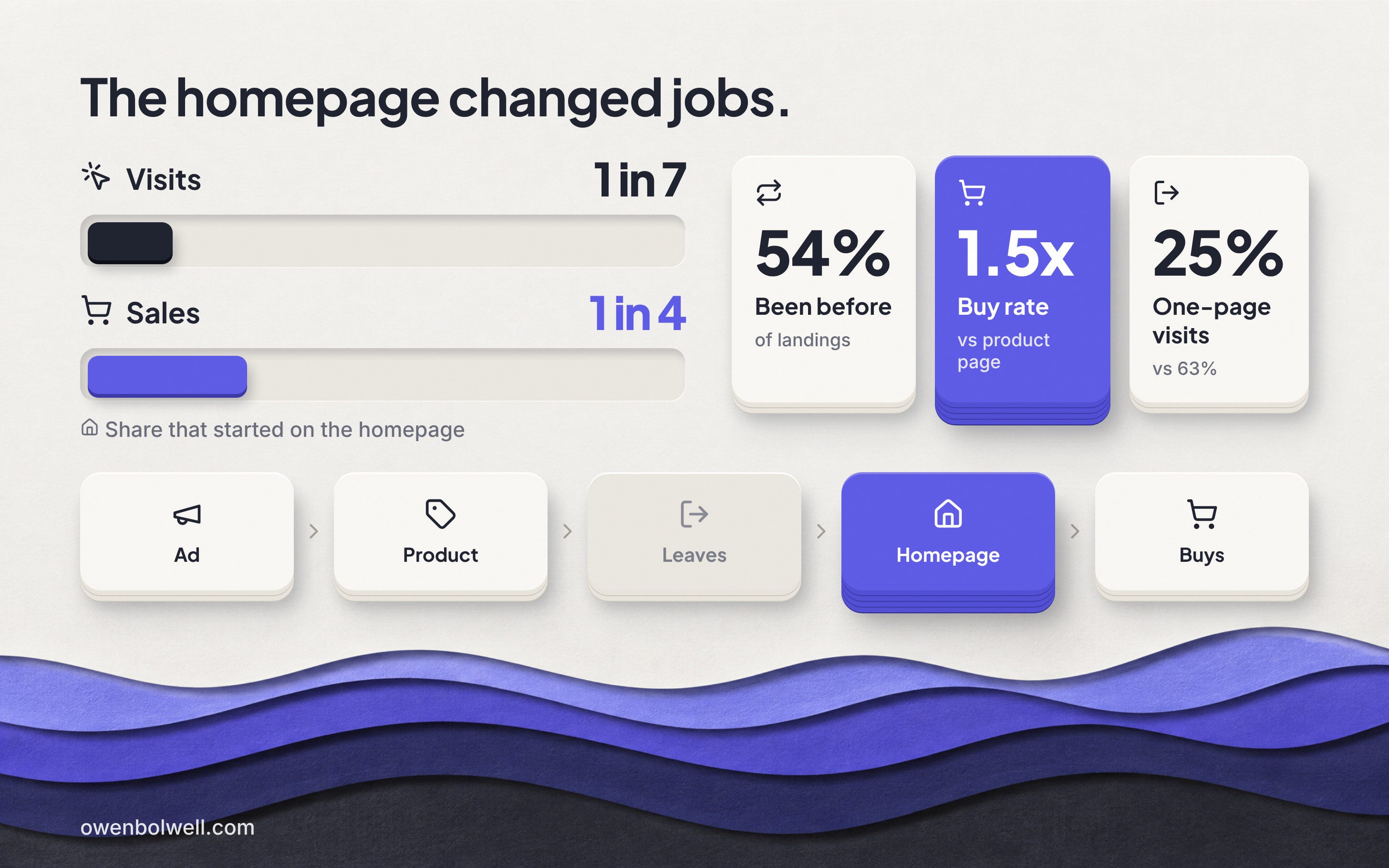
I pulled some data from a retail brand I work with. Over the last 90 days, about one visit in seven started on the homepage, and those visits produced just over a quarter of the visits that ended in a sale.
These days, my focus is optimising everything after your potential customer clicks an ad and product pages tend to take most of my attention. So it’s a nice sidetrack to go and explore the role of the homepage in this new ecom environment.
The rise of agentic shopping on top of your paid acquisition means your product and collection pages are working harder than ever. Over last year’s BFCM, Yottaa found only 2.6% of visits referred by AI tools across nearly 700 sites started on a homepage, and 77% started on a product page.
My client’s homepage appears to be getting less of its fair share of new visits than we expected. It’s not the front door it once was. It’s job has changed. It’s become validation for someone who’s already half way made the decision to buy.
For someone landing on your product page, finding brand signals often require effort and a click on the logo to the homepage is easier.
When you think about it, your homepage has always been about brand.
Fewer visitors start their store journey there and the ones who do are among your most valuable because half of homepage visitors come direct or from a brand search, not a product search. This cohort is actively looking for your brand. They know you. Now it’s your job to get them to like and trust you, whether they’re coming from a Google search or one of your product pages. And here’s our opportunity to optimise it.
What does the homepage do now?
My take is that homepage visitors already know the brand. More than half of those visitors had been to the site before. Click a brand search link and you’ll usually land on a homepage.
For this client, even with one visit in seven, the homepage certainly looked like it was doing some heavy lifting on conversion.
We also found that over the past year, new visitors who came in to the homepage bought at about one and a half times the rate of new visitors who landed on a product page.
Returning visitors showed almost the same gap, at around 1.4 times. And they stuck around. Over the 90 days, a quarter of homepage visits left after one page, against nearly two-thirds of product-page visits.
Then there’s visits from paid social. Fewer than one in two hundred visits (0.4%) from the brand’s Meta ads started on the homepage, which you’d expect. And those ad visits almost never ended in a sale on the first visit.
This is normal for an audience with an average purchase consideration timeframe of 50-60 days and a dozen touch points along the way but it certainly keeps the ad agency on their toes.
Around one in six returning visitors who came in through this brand’s homepage had arrived from a Meta ad on their previous visit. Most likely they saw the ad, had a look, left, and came back later through the front door to check the brand out properly.
The pattern seems to hold up beyond this brand. Across 117 European brands, Drip Agency’s 2026 benchmark put median conversion at 0.81% for paid social, against 3.70% for direct traffic.
The product page the ad click lands on makes the introduction (yep, that’s the product I’m looking for…) and the homepage is where the validation occurs and we see a return on all our marketing efforts (what’s this brand all about, then…).
Why brand, and not conversion?
A visitor on your homepage has probably decided on your product. Now they’re deciding if you are the kind of brand they want to buy from. we’re talking brand story, values, look, feel and continuity of the message in the ad that brought them here in the first place. This is all brand. The sale banner and collection carousel may not be doing as good a job as it was doing a few years ago.
The homepage is where story, photography, art direction and the voice of the brand have a page to call home. It’s a page you own. There’s no ad platform messing with your visuals and no marketplace template flattening your brand into a grid of sameness and competitor alternatives.
One brand, one category
Now to be fair, this is my own research on one brand, in one category. Customers take their time over expensive things and in a cheaper, impulse purchase category we’d expect more immediate conversions and leaving and coming back later through the homepage.
Two things in the data favour my homepage idea. A sale is credited to the visit it happened in, so a purchase made days and a dozen touch points after the ad click lands on the return visit. And a “new” visitor could easily be a new device, so someone who clicked a Meta ad on mobile and later typed the URL on their laptop counts as new.
The data shows us the path someone took. It doesn’t show why they came back.
Regardless, visit for visit, this brand’s homepage contributes to conversion better than its product pages on their own, for new and returning visitors alike.
What I’d do
I’d start by finding out who’s landing on your homepage. Use these four metrics: how many visitors are new; how many typed your name to get there; where they go next; and how often they buy compared with people who land on a product page.
If yours look like mine, your homepage is serving people who already know you or checking you out after an ad.
Then measure it by how many people come back through your homepage after clicking an ad, and how many of them go on to buy.
Pull your own numbers this week, then look at your homepage. Who is it talking to?